
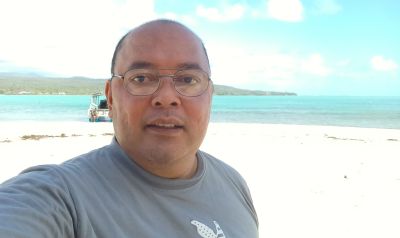
With over 20 years of experience in laboratory management, environmental science, and renewable energy research, WLI participant and Research Laboratory Manager, Carel Samani Tupufia from Samoa, is actively contributing to the advancement of sustainable energy and environmental solutions across the Pacific.
In his current role as Research Laboratory Manager at the National University of Samoa, he manages research laboratory operations, oversees herbarium research, and leads initiatives in renewable energy and sustainability, including feasibility studies for solar energy projects. He also supports faculty research, mentors graduate students in laboratory methodologies, and fosters stakeholder collaboration to address critical energy challenges facing Samoa and the wider Pacific region.
"My work reflects a deep commitment to sustainability, leveraging analytical skills to support innovative solutions for environmental and energy challenges," says Carel, who obtained a Master of Science in Biotechnology from The University of New South Wales (UNSW).
Explaining why he chose to study his Masters at UNSW, Carel said he knew the course would equip him with the scientific skills required to understand all the pathways and options for tackling the Pacific region’s energy crisis, so he could “go back home and help Samoa, and the Pacific region, to pursue real energy independence and better prepare for the future.”

Sustainable, real-world solutions
From converting coconut oil into biodiesel to using ultrasound to speed up reactions and turning waste glycerol into animal feed, Carel’s research focuses on practical, sustainable solutions.
“In my current role, my work focuses on two main areas: advancing renewable energy research particularly solar energy projects and supporting faculty and student research across environmental and scientific disciplines,” explains Carel.
Carel views his role as a bridge between academic research and real-world solutions for Samoa and the Pacific.
“Whether it’s guiding a student’s biofuel project or collaborating with partners on climate change mitigation, my aim is to build local capacity and contribute to a more sustainable, energy secure future for our region,” he says.
Carel’s WLI journey
Carel first came across the WLI program through a combination of professional networking and his own research.
“Colleagues spoke highly of the program's impact on their careers and its commitment to developing leadership in sustainability and renewable energy. Their encouragement, along with my own research, motivated me to apply for 2026’s LeadershipConnect program,” recalls Carel.
“As a Master's graduate with a background in renewable energy and several years of experience working with the Government of Samoa, I was eager to make the most of the opportunity offered by the LeadershipConnect program. I wanted to further my knowledge in two key areas: strengthening my leadership skills and staying current with emerging technologies, particularly artificial intelligence. Ultimately, I’m driven by a genuine desire to keep learning and growing, and I believe WLI’s LeadershipConnect program is the perfect platform to do so.”
Making an impact through effective leadership
Carel credits LeadershipConnect for opening his eyes to several key insights on leadership.
“Firstly, effective leadership comes in many forms, but common elements include showing respect, being understanding, staying positive, and aligning yourself with both the people you lead and those you collaborate with. Confidence is critical but so is knowing your own agenda and staying true to it,” says Carel.
“Leadership is not about rigid control; it is about adapting and genuinely connecting with others.”
In response to what leadership impact he hopes to have in his local community and country, Carel says he wants to “lead Samoa and the wider Pacific toward true energy independence and climate resilience.”
“I want to bridge the gap between scientific research and real-world application, and lead teams that turn laboratory breakthroughs into working, community level energy solutions,” says Carel.
“I also want to build local capacity. I have mentored students and managed multidisciplinary teams, and I want to continue developing the next generation of Pacific scientists, engineers, and leaders; people who understand our unique island challenges and can solve them from within.”

Additionally, Carel wants to help drive decarbonisation and energy transition across the Pacific region.
“Through my work I’m already contributing to electric vehicle transitions and carbon reduction strategies. My vision is to see Samoa become a model for other Pacific nations showing that renewable energy, sustainable biofuels, and smart policy can work together to reduce our dependence on imported fossil fuels. In short, the leadership impact I want is a Samoa that is energy secure, environmentally protected, and led by skilled, confident local experts. I want to be part of making that future real.”
Working together to make a difference
Recognising his role as a WLI male participant and ally, Carel spoke about how women and men can work together more effectively to achieve renewable energy in the Pacific.
“Gender equality is increasingly being recognised as a critical issue in Samoa and across the whole region. In my own experience managing biomass gasification plants and research laboratories, I’ve seen that the best outcomes come when diverse voices are heard and respected. Teaching both young women and young men to value each other's contributions early on builds a foundation of mutual respect,” says Carel.
“Positive development in the Pacific depends on all of us women and men recognising that we are stronger together.”
Carel adds that it’s not enough to have a gender equality policy on paper alone – tangible, real-life changes are vital.
“In Pacific workplaces, we need clear targets for women's participation in renewable energy projects, environmental assessments, and technical roles. We also need flexible work arrangements and safe reporting mechanisms. When policies are backed by resources and accountability, real change happens.”
For Carel, promoting collaborative leadership models is also key.
Pacific societies have traditionally valued consensus and community. We can build on that strength by encouraging shared leadership – where women and men co lead projects, co facilitate meetings, and co design solutions. In my work on biodiesel research and decarbonisation projects, I’ve found that mixed teams bring better problem solving and more sustainable outcomes. Men can actively mentor women, and women can mentor men; it is about learning from each other.”
“Finally, we must celebrate and amplify success stories,” adds Carel. “When a female engineer leads a solar project, or a male conservation officer champions women's voices in village meetings, those stories inspire others. Positive development in the Pacific depends on all of us women and men recognising that we are stronger together.”
Learn more about the LeadershipConnect program.